Xycoon logo
Bayes Theorem
Home    Site Map    Site Search    Xycoon College    Free Online Software    
horizontal divider
vertical whitespace

Introduction to Econometrics - Bayes Theorem

[Home] [Up] [Probability] [Axiom System] [Random Variables] [Matrix Algebra] [Distribution Theory] [Estimator Properties] [Bayes Theorem]


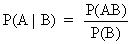
As defined earlier

Introduction to Econometrics - Bayes Theorem

(I.II.1)

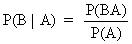
and of course

(I.II.2)

Since P(A B) = P(B A) it follows by substituting (I.II.2) into (I.II.1) that
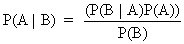
(I.II.3)

Equation (I.II.3) shows clearly that the chance of A given B can be expressed as a function of the chance of B given A!

The left hand side of (I.II.3) is called the posterior probability,

P(A) is called the prior probability, and P(B) is the probability of B whether A is true or not.

It is quite obvious that (I.II.3) can be rewritten as:

(I.II.4)

where A has been replaced by H (a hypothesis) and B by D (observed data).

In other words: the probability of the hypothesis being true, given the fact that specific data have been observed, varies with the likelihood of the observed data when the hypothesis is true times the prior probability (subjective probability) of the hypothesis.

As a matter of fact, equation (I.II.4) is a simplified version of Bayes' theorem. By extending (I.II.4) just a little bit, a very useful equation can be found. In fact one only has to think of two different hypotheses Hyp1 and Hyp2 and apply equation (I.II.4) to them.

It is easily found that
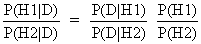
(I.II.5)

or in words: the posterior odds equal the likelihood ratio multiplied by the prior odds (Bayes' theorem).

The only question remaining is: how can this theorem be applied usefully in practice? A very simple example should clarify the usefulness of this theorem.

Suppose that there are two sacks of gold and silver coins. Both have been shuffled thoroughly. Denote the first sack as Hyp1 and the second as Hyp2. Furthermore, it is known that in the first sack there are 150 gold coins and only 50 silver coins, in the other sack there are 100 and 200 coins respectively.

Suppose that one had the opportunity to draw a coin out of one sack, and suppose that one would pick a gold coin. What is the chance of the drawn coin to come from the first sack?

Assuming that both sacks have the same chance of being picked, not regarded the outcome of the drawing, this problem can be solved quite easily by applying Bayes' theorem as follows:
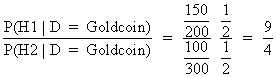
(I.II.6)

An important issue, when applying Bayes' theorem or Bayes' regression techniques is that there always is a subjective (prior) probability that is being incorporated in solving the problem. This can be of great importance (e.g., if the researcher has expert knowledge on some events and can therefore influence the outcome of the investigation with his "a priori" assumptions/knowledge). At the same time this prior probability could be regarded as an immense drawback when wrongly used or interpreted.

From now on the discussion of classical econometrics will be our primary target. The classical approach does not use a priori knowledge to the full extent as in the Bayes' method, even if there are important economic theories that are known to be true.

From now on the economic theory will only be used as a guideline for econometric specifications and checking of econometric models a posteriori.

vertical whitespace


Home
Up
Probability
Axiom System
Random Variables
Matrix Algebra
Distribution Theory
Estimator Properties
Bayes Theorem
horizontal divider
NEWS FEED from BBC News : Statistical Research
Are 1.3m yogurts really binned a day?Recent research found that 1.3 million unopened yogurts are thrown away in the UK every day - how on earth did they find that out?
Lab animal numbers continue trendThe number of animals used in UK labs for scientific experiments is now more than three million - a level not seen since 1992.
Safety in numbersAlarming stories of a rise in knife crime + lack of confidence in understanding statistics = more fear for ourselves and our children, says Lisa Jardine.
Five reasons to be cheerful amid the gloomFeel the gloom. With more bad news on the economy this week, is there no comfort, no end to pessimism? Yes! The Magazine challenged statistical sleuths Michael Blastland and Andrew Dilnot to scour the data - and find us five reasons to be cheerful.
Analysis: Crime figures downWhat should we make of the latest figures on crime in England and Wales?
Knife crime cuts a global trailAs the UK debates rising knife crime, BBC correspondents reveal how other countries are affected.
Is knife crime really increasing?With stabbings in the spotlight again after four men are killed in one day, is knife crime worse than ever?
Eng v SA 1st Test: day two as it happenedIan Bell hits a magnificent 199 as England declare on 593-8 on the second day of the first Test against South Africa.
Most Muslim coverage 'negative'Cardiff University research says newspaper coverage of UK Muslims in the past eight years is mainly negative.
Is Scotland's dust behind asthma?A BBC Scotland investigation looks at whether the house dust mite is responsible for a rise in asthma
Gender 'impacts on transplants'Women who get a replacement kidney from a male donor are more likely to reject the new organ, scientists suggest.
Watchdog debates exam difficultyEngland's exams watchdog wants experts to debate evidence that some subjects are harder to get good grades than others.
No pregnancy pact, says US mayorThere is no evidence that 17 Massachusetts schoolgirls became pregnant because of a "pregnancy pact", the town's mayor says.
Watchdog: Degree grades arbitraryThe universities' watchdog has warned of problems with degree grades and overseas student over-recruitment, reports Sean Coughlan.
India baby girl deaths 'increase'Growing numbers of female foetuses are aborted and baby girls left to die in India, a UK charity says.
Men with HIV 'having unsafe sex'Some gay men who are HIV positive are still having unprotected sex, a study suggests.
US fears of teen 'pregnancy pact'US officials investigate an apparent pregnancy pact at a school that has resulted in 17 teenagers expecting babies.
How hard do our Welsh MEPs work?Researchers publish details of just how many meetings, questions and speeches Euro MPs really make.
Can web predict economic gloom?Gambling, guns and religion, would you associate them with an economic downturn?
Whistleblower warning on degreesDegrees are being awarded to overseas students who speak almost no English, claims a lecturer, reports Sean Coughlan.
horizontal divider

© 2000-2006 - Office for Research, Development, and Education (called ORDE) - All rights reserved. This website is published by ORDE and owned by Resa R&D. This includes: html content, graphical illustrations (gif, jpg, and png files), computer software, online or electronic documentation, associated media, and printed materials. All Photographs (jpg files) are the property of Corel Corporation, Microsoft and their licensors. ORDE has acquired a non-transferable license to use these pictures in this website.
The free use of the scientific content in this website is granted for non commercial use only. In any case, the source (url) should always be clearly displayed. Under no circumstances are you allowed to reproduce, copy or redistribute the design, layout, or any content of this website (for commercial use) including any materials contained herein without the express written permission of ORDE.

Information provided on this web site is provided "AS IS" without warranty of any kind, either express or implied, including, without limitation, warranties of merchantability, fitness for a particular purpose, and noninfringement. ORDE uses reasonable efforts to include accurate and timely information and periodically updates the information without notice. However, ORDE makes no warranties or representations as to the accuracy or completeness of such information, and it assumes no liability or responsibility for errors or omissions in the content of this web site. Your use of this web site is AT YOUR OWN RISK. Under no circumstances and under no legal theory shall ORDE be liable to you or any other person for any direct, indirect, special, incidental, exemplary, or consequential damages arising from your access to, or use of, this web site.

Contributions and Scientific Research: Prof. Dr. E. Borghers, Prof. Dr. P. Wessa
Please, cite this website when used in publications: Xycoon (or Authors), Statistics - Econometrics - Forecasting (Title), Office for Research Development and Education (Publisher), http://www.xycoon.com/ (URL), (access or printout date).
Facilities, development, and design: Office for Research, Development, and Education

Comments, Feedback, Bugs, Errors | Privacy Policy Web Awards

This website is kindly sponsored by: Bandwidth Control | Time Series, Statistics Resources, and Statistics Software | Computer schools and technology degrees