Xycoon logo
Demand Systems
Home    Site Map    Site Search    Xycoon College    Free Online Software    
horizontal divider
vertical whitespace

Formal derivation of demand systems

[Home] [Up] [Rotterdam Model] [Differential Demand] [Differential Input] [Other models] [Formal Derivation]


IV.I.1 Formal derivation of demand systems

The objective in non-probabilistic consumer behavior is to maximize utility such that a budget constraint is satisfied. If U(q) is twice continuously differentiable (then the Hessian of U(q) is symmetric and) then it is possible to obtain a Marshallian demand function q = q(m, p) (which is dependent on the known budget m and a known price vector p (h*1)) where q (h*1) contains the consumption quantities for a set of h commodities such that U(q) reaches a maximum subject to p'q = m:

Formal derivation of demand systems

(IV.I.1-1)

The optimization problem can be formulated as a Lagrange function

(IV.I.1-2)

The first order conditions are
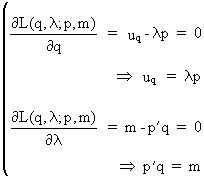
(IV.I.1-3)

Remark that it is implicitly assumed that U(q) is stationary in its optimum and that all marginal utilities are positive.

Since the marginal utilities and (obviously also) prices are strictly positive, the Lagrange multiplier (in (IV.I.1-3)) must be positive as well.

The second order condition must be satisfied in the maximum:
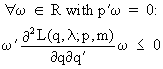
(IV.I.1-4)

It can be shown that under strict quasi-concavity of utility (c.q. strict convexity of the iso-utility curves), that (IV.I.1-4) is satisfied.

It can also be shown that a unique solution exists for q = q(m, p), and the Lagrange multiplier, for which the solution follows from (IV.I.1-3) as
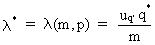
(IV.I.1-5)

where q* = q(m, p).

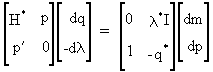
Obviously (IV.I.1-3) can be written as a differential
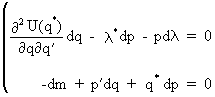
(IV.I.1-6)

or
(IV.I.1-7)

where H* is the Hessian matrix of the utility function U(q*).

On noting that we already defined

(IV.I.1-8)

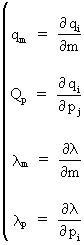
and if we define
(IV.I.1-9)

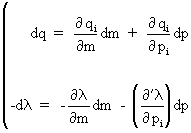
it is possible to write
(IV.I.1-10)

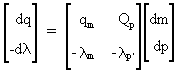
or equivalently
(IV.I.1-11)

We interpret qm as the vector of marginal income sensitivities of consumption, and Qp as the matrix of marginal price sensitivities of consumption. Remark that the diagonal elements of Qp are the price sensitivities, whereas the off-diagonal elements are the cross-price sensitivities.

By combining (IV.I.1-7) and (IV.I.1-11) we find
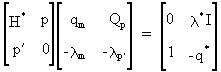
(IV.I.1-12)

It is possible to prove that q = q(m, p) is continuously differentiable if and only if
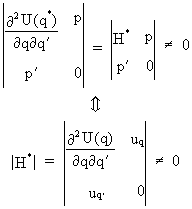
(IV.I.1-13)

so that the property of differentiability holds if the Hessian of the utility function is non-singular.

It can be shown that if U(q) is assumed to have a decreasing marginal rate of substitution (MRS) that H* is non-singular. Therefore if U(q) has a diminishing MRS, the demand equations are continuously differentiable.

Since we know that H* is a symmetric matrix, it follows that
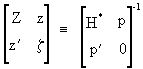
(IV.I.1-14)

is also symmetric.

On substituting (IV.I.1-14) into (IV.I.1-12) we find
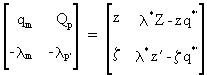
(IV.I.1-15)

In (IV.I.1-15) it is quite obvious to see that

(IV.I.1-16)

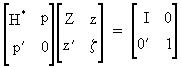
Furthermore we can rewrite (IV.I.1-14) as
(IV.I.1-17)

thus

(IV.I.1-18)

and

(IV.I.1-19)

and

(IV.I.1-20)

and

(IV.I.1-21)

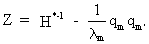
Now it follows from (IV.I.1-18) and (IV.I.1-19) that
(IV.I.1-22)

which implies that Z is symmetric (since H* is symmetric). Above this the inverse of the Hessian matrix has negative diagonal elements which is equivalent to saying that the indifference curves are convex (see (IV.I.1-4)).

Equation (IV.I.1-20) implies homogeneity meaning that substitution effects are in fact a reallocation of goods without changing the overall level of consumption. Therefore only the relative price changes are important for substitution effects.

In (IV.I.1-21) the adding up property is illustrated. All prices multiplied by their respective propensity to consume sum up to one (i.e. a weighted sum of budget elasticities of demand).

From (IV.I.1-11) we find quite easily

(IV.I.1-23)

Partial substitution of (IV.I.1-15) into (IV.I.1-23) yields

(IV.I.1-24)

From (IV.I.1-16) equation (IV.I.1-24) becomes

(IV.I.1-25)

Substituting (IV.I.1-22) into (IV.I.1-25) gives

(IV.I.1-26)

which is the structural form of our (general) demand system where the first term is attributed to the income effect whereas the second term takes the substitution effect into account.

The substitution effect, due to Hicks and Allan, is given by

.

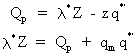
This can be shown quite easily by using (IV.I.1-15) and (IV.I.1-16)
(IV.I.1-27)

which is just a "compensated price effect" (due to Hicks). In micro economics the Hicksian demand function is equal to the Marshallian function which is "compensated" for the change in real income (such that the original utility level is attained).

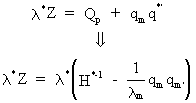
Thus from (IV.I.1-27) and (IV.I.1-22) we obtain
(IV.I.1-28)

and thus the second term of (IV.I.1-26) represents the substitution effect.

vertical whitespace


Home
Up
Rotterdam Model
Differential Demand
Differential Input
Other models
Formal Derivation
horizontal divider
NEWS FEED from BBC News : Statistical Research
Assembly spends £4.6m on adviceThe assembly government's bill for outside experts more than doubled in four years, Welsh Lib Dem research shows.
Smiles and scowls 'in our genes'The facial expressions we make to show or hide our emotions are hardwired into our brains, a study concludes.
'Boom year' for hi-tech criminalsSecurity experts say 2008 was a boom year for hi-tech criminals and the net's underground economy.
Gloomy prediction for UK economyAn independent group of economists forecasts the biggest contraction in the UK economy since 1946 next year.
Job prospects fall for minoritiesEmployment prospects for men from ethnic minorities have worsened says an Oxford academic.
Jack and Katie still number oneJack and Katie were still the most popular baby names in 2008 among parents in Northern Ireland.
'Aspiration gap' for white poorThe aspirations of young people, especially boys, from white working class communities must be raised, says a report.
India v England: 1st Test day five as it happenedSachin Tendulkar scores his 41st Test century as India score 387-4 to beat England by six wickets in Chennai.
Mapping UK's teen murder tollMore than 70 teenagers have been killed in the UK in 2008 but the deaths are concentrated in a handful of cities and most police forces have not seen a case of teen murder or manslaughter this year.
Therapy hope for eating disordersA form of cognitive behaviour therapy could benefit most people with eating disorders, a study suggests.
Will we be howling at the moon?The full moon has long been blamed for sending people mad and women into labour in popular folklore, but is there any truth to the notion.
UK economic slowdown 'worsening'The UK economy contracted 1% from September to November, the National Institute of Economic and Social Research calculates.
Vitamins 'do not cut cancer risk'Taking vitamin C, E or selenium does not reduce the risk of prostate cancers - or other forms of the disease, studies suggest.
Earthquakes can 'spark eruptions'Very large earthquakes can trigger an increase in activity at nearby volcanoes a scientific study claims.
How independent is independent?Mike Baker looks at what needs to be done to restore trust in the exam system.
Intelligent 'have better sperm'Men of higher intelligence tend to produce better quality sperm, UK research suggests.
Who is looking at your medical records?A series of new NHS data sharing initiatives is raising concerns about patient confidentiality.
Baby decisions - adding to the world's woes?As you decide whether or not to have children, should you take the world's increasing stack of environmental woes into account?
'Apathy rules' for voters in NISince 1945, there has been a steady decline in the number of people who vote in elections in NI according to research commission by the BBC.
Young people abandoning CumbriaCumbria has not suffered an exodus of people like many UK regions but young people are not choosing to live there, a BBC survey finds.
horizontal divider

© 2000-2008 - Office for Research, Development, and Education (called ORDE) - All rights reserved. This website is published by ORDE and owned by Resa R&D. This includes: html content, graphical illustrations (gif, jpg, and png files), computer software, online or electronic documentation, associated media, and printed materials. All Photographs (jpg files) are the property of Corel Corporation, Microsoft and their licensors. ORDE has acquired a non-transferable license to use these pictures in this website.
The free use of the scientific content in this website is granted for non commercial use only. In any case, the source (url) should always be clearly displayed. Under no circumstances are you allowed to reproduce, copy or redistribute the design, layout, or any content of this website (for commercial use) including any materials contained herein without the express written permission of ORDE.

Information provided on this web site is provided "AS IS" without warranty of any kind, either express or implied, including, without limitation, warranties of merchantability, fitness for a particular purpose, and noninfringement. ORDE uses reasonable efforts to include accurate and timely information and periodically updates the information without notice. However, ORDE makes no warranties or representations as to the accuracy or completeness of such information, and it assumes no liability or responsibility for errors or omissions in the content of this web site. Your use of this web site is AT YOUR OWN RISK. Under no circumstances and under no legal theory shall ORDE be liable to you or any other person for any direct, indirect, special, incidental, exemplary, or consequential damages arising from your access to, or use of, this web site.

Contributions and Scientific Research: Prof. Dr. E. Borghers, Prof. Dr. P. Wessa
Please, cite this website when used in publications: Xycoon (or Authors), Statistics - Econometrics - Forecasting (Title), Office for Research Development and Education (Publisher), http://www.xycoon.com/ (URL), (access or printout date).
Facilities, development, and design: Office for Research, Development, and Education

Comments, Feedback, Bugs, Errors | Privacy Policy Web Awards